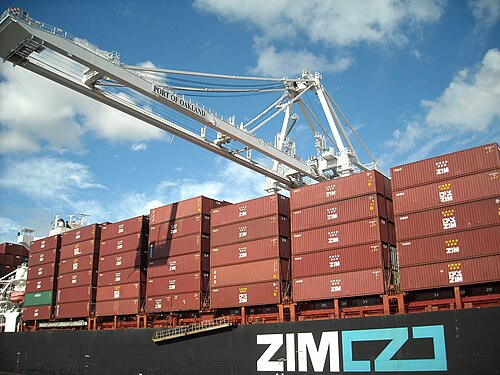

The Economic Affairs Committee, chaired by MK David Bitan (Likud), convened on Sunday in the wake of the deal for sale of the ZIM shipping company, and held a debate dealing with the sale’s strategic ramifications for Israel’s security and independence. Committee Chair MK Bitan noted that this was a follow-up to a debate held about a month ago, following reports about the signing of the deal. MK Oded Forer (Yisrael Beitenu), who initiated the debate, said that this was a strategic event for the State of Israel, and that according to reports published, the structure of the deal raises serious concerns that a weak company would be established that would not be able to bear the national responsibility of [serving as] an Israeli shipping company.
Ariel Aminetzah, representative of the ZIM board of directors, stated that ZIM had answered the letters of the Government Companies Authority (GCA) and was preparing the necessary documents. “When the documents are ready, we will submit them to the GCA according to procedure, so we thought that the [committee] debate was a bit premature,” he said. Dr. Yoram Sebba, President of the Israel Chamber of Shipping, said that the debate was certainly not premature, and noted that ZIM’s fleet of ships was relatively old, and that in about a decade it would be necessary to replace it at a cost of about USD 1 billion.
Conversely, Galit Widerman, Senior Deputy Director General at the Government Companies Authority, said that she had sent four separate letters and warned that [ZIM] was obligated to comply with the conditions of the “golden share” and submit the details to the GCA even before the deal was signed. Widerman said, “The company could provide the best lawyers and submit the full details requested by the GCA.” She also criticized the absence of the company’s representatives from the debate, saying that it appeared that ZIM did not respect either the state agencies or the Knesset.
Committee Chair MK Bitan said that the Saudis and the Qataris were able to buy everything within a minute, but this did not mean that they should be allowed to do so.
FIMI Opportunity Funds founder and CEO Ishay Davidi said, “We are going to establish the new ZIM, which will meet the maritime and economic security [requirements], and is very strong. FIMI will be the 100% owner of the new ZIM. We are establishing a company with USD 700 million in equity, and no debt at all. ZIM, as of today, has liabilities on the ships amounting to USD 5–6 billion, and we have no such [liabilities]. The 16 ships, of which 12 are fully-owned by us, are going to be newer than what ZIM has.”
Committee Chair MK Bitan asked whether in the next war ZIM would be able to provide all the state’s needs, and Davidi replied, “Yes, with an exclamation point.” Davidi said further that in the past, ZIM faced bankruptcy twice and did not meet the conditions of the golden share, while the new ZIM would be profitable with certainty from the first day. “There will not be a situation in which the new ZIM does not comply with the State of Israel’s requirements,” he said.
Shipping and Ports Authority Director Capt. Zadok Redker said, conversely, “At least judging from the information we have received from the media, we do not see anything good for the state. We know with certainty that the shipping sector is headed for a slump, and that strengthens the declarations that the scaled-down Israeli company does not have economic feasibility. I would be glad to know how it will be profitable from the first year. We see no chance that this will last. Shipping is a business with insanely high expenses, and you reach an uncomfortable economic situation very quickly. The information was concealed from us, they were only able to give certain statements to the press, and judging from the information we have we don’t see anything good in this deal.”
Oren Caspi, chair of the ZIM workers’ union, said that in the next war, [Israel] would be dependent for imports from East Asia on Hapag-Lloyd, which has representatives from Qatar and Saudi Arabia, and the state would not be independent. As for the workers, Caspi said, “They threw us to the dogs. From 1,000 workers, they are offering 120 workers a contract for a year only. There is dirty Qatari money here, and we hope that the state will come to its senses and not let this happen.” Histadrut representative Nir Eisenberg added, “We are getting an offer to exchange an apartment in Tel Aviv, which has a mortgage attached, with a debt-free apartment in Kiryat Gat. There are a thousand families here that received the news through the newspaper, and that is a disgrace. We will fight this all the way.”
Ministry of Defense official Shay Halperin said that since October 7, [Israel] had been in a security crisis, and ZIM provided a response where it was necessary. He said, “It’s important that the state be able to continue to take security equipment, otherwise we won’t be able to bring to here what the IDF and the defense establishment need.”
Committee Chair MK Bitan said in summation that he was requesting that ZIM submit the information to the state, and was requesting that the GCA conduct a preliminary check of the matter with FIMI Funds, to ensure that the firm was capable of meeting the conditions and to find out what guarantees it was giving. He added that he intended to hold a classified meeting on the security problems, and what needed to be done in order to meet the conditions. Davidi said in response, “We wouldn’t have entered the deal if we hadn’t met all the conditions requested by the state.” MK Forer said, “Something very troubling has been revealed here, that the current ZIM did not meet the conditions of the golden share, and that should trouble us. The Government should ensure that Israel has transportation continuity at sea, including in wartime.”
Economic Affairs Committee discusses ZIM deal
Committee Chair MK Bitan: In the next war, will ZIM be able to provide all the state's needs? FIMI Funds CEO: Yes!